
The Journal
How to Plan a Winter Hike Before Sunset
Learn how to check local sunset, estimate your full winter hike and set a turnaround time with a practical daylight worksheet.
November 5, 2026
A winter hike is planned around two times. The first is local sunset. The second is the time you need to be back to the trailhead. These are not necessarily the same.
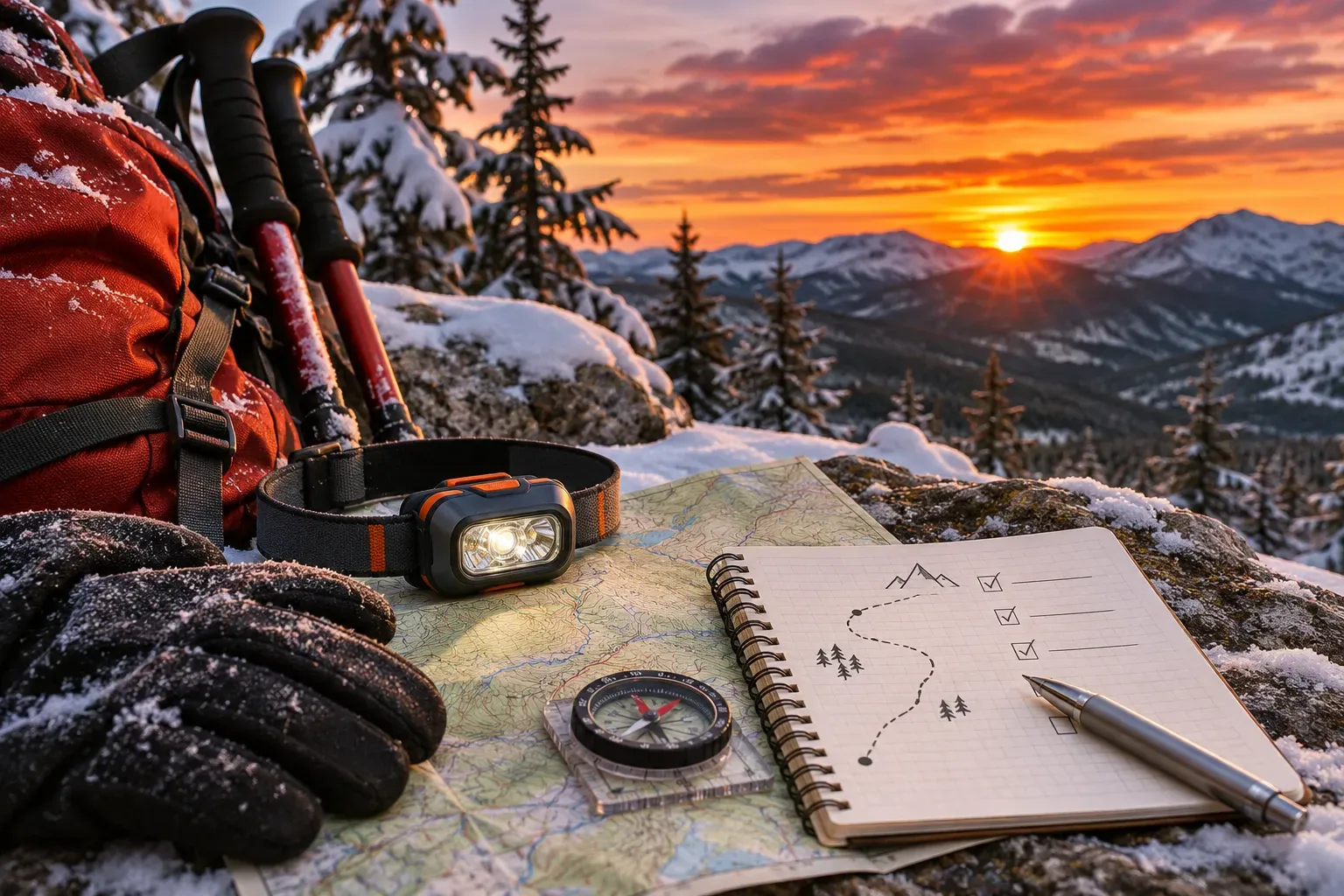
Determine the daylight for the date and location of your hike. Now estimate your overall outing, including the return, stops and possible slow-downs. Set a turnaround time before you start. If you need to, turn back sooner due to the ground or group. Even if you plan on being done well before sunset, you should have a headlamp in your pack.
Why Winter Daylight Changes Your Plan
The daylight available for a winter hike is dependent on latitude, time of year and location. You can’t use a universal time for all parks. For instance, the National Park Service states that for mid-December, Denali National Park and Preserve has sunrise around 10:30 a.m. and sunset around 3 p.m. These are approximate local examples, not to be used elsewhere.
Find the Correct Sunrise and Sunset Times
Determine the date and a location near your trailhead. The U.S. Naval Observatory provides data services with sunrise, sunset and twilight times for specific locations. You can also use local forecasts or park information. Be sure to use the proper time zone and date, especially if you cross a boundary or use a saved screenshot.
Determine the times for sunrise and sunset. Also, be sure that the road, parking area and trail are open. You may be limited in your outing before sunset by a gate closing time. Be sure to check the current notices for the trail and road, forecast and any winter travel rules for the managing agency before you go. Don’t assume you can use a posted closure as extra time. Find a different route. To read a cold, windy forecast, see wind chill vs. temperature for walking.
You can use the calculated sunset as a reference, but don’t treat it as a light meter for each curve on the trail. The Naval Observatory states that their standard calculations use a level horizon and average atmospheric conditions. But your route could be affected by terrain, clouds and trees. You might find a valley or wooded area darker before the stated sunset. Plan for an earlier return if conditions warrant it.
Estimate the Full Outing
Moving time
Determine the route distance you can use, not some old, closed route. Estimate the moving time. Base it on a reasonable pace for the slowest person in your group on similar terrain. Don’t assume a dry summer walk is a winter guarantee. It’s a starting point for thinking about it.
Rest and photo stops
Consider time for stops, snacks, taking photos, checking the map, helping kids or other group members. Stops are part of the outing even if your watch stops. Estimate before you go, then compare it to the clock during the hike.
Slower terrain and weather
Snow, ice and poor visibility can slow you down and make it harder to follow the route. The Park Service states that the time for their Sunset Rock winter route can vary based on snow conditions, fitness and stops. They don’t recommend hiking that particular snowy or icy trail without traction devices. They state it is a ski trail, but can also be used for snowshoeing.
Return-trip allowance
Estimate the return trip separately. Consider the ground you need to cover, remaining stops and a reserve for delays. There isn’t a single safe extra margin for all trails. Consider the group, route, weather and consequences of delay for a reserve. Be prepared to shorten or cancel the trip if you can’t make a reasonable plan.
With an out and back route, the time you spend going out is good evidence, but the return may be different. For a loop route, know where an authorized shorter route goes. Is it open? Don’t invent an escape route over closed ground.
Set a Turnaround Time
Set a planned time to be back at the trailhead earlier than sunset. Consider the terrain, light and conditions you expect. Subtract your estimated return time and delay reserve. This is the latest time you’ll decide to start back from your planned turnaround point. You may need to turn back earlier if conditions change or you don’t have enough time based on the estimate.
For the purpose of illustration only, here’s a made up example. It was prepared on November 5, 2026. This isn’t a forecast or recommendation for a real park.
| Daylight budget | Hypothetical time |
|---|---|
| Listed local sunset | 4:30 p.m. |
| Chosen trailhead return target | 3:30 p.m. |
| Estimated return from planned turnaround | 1 hour |
| Reserve for delay | 30 minutes |
| Latest time to start back | 2:00 p.m. |
3:30 p.m. minus 1 hour minus 30 minutes = 2:00 p.m. This is an example, not a safety standard. If you start out at noon and get to your planned point at 1:30 p.m., you can start back. If 2:00 p.m. arrives first, you turn back wherever you are. If the trail is difficult earlier, you’ll decide sooner.
Two hypothetical winter itineraries
The examples below both use made up dates, daylight and route estimates. These are arithmetic exercises prepared on November 5, 2026. This is not current for named parks. This isn’t a guarantee of a safe outing. For each example, we assume an open out and back route and a group that can travel on the stated terrain.
| Planning item | Shorter daylight example | Longer daylight example |
|---|---|---|
| Invented date and daylight | December 15. Sunrise 10:00 a.m., sunset 3:30 p.m. | February 15. Sunrise 7:00 a.m., sunset 5:30 p.m. |
| Trailhead start | 10:30 a.m. | 9:00 a.m. |
| Intended return | 2:30 p.m. | 4:00 p.m. |
| Planned outward travel and stops | 1 hour 15 minutes | 2 hours, including stops |
| Estimated return from planned point | 1 hour 15 minutes | 2 hours |
| Delay reserve | 30 minutes | 1 hour |
| Latest time to start back | 12:45 p.m. | 1:00 p.m. |
| Planned arrival at turnaround point | 11:45 a.m. | 11:00 a.m. |
In the first example, 2:30 p.m. minus 1 hour 15 minutes and 30 minute reserve = 12:45 p.m. In the second example, 4:00 p.m. minus 2 hours and 1 hour reserve = 1:00 p.m. Notice that there’s unused time in each schedule. We’ve planned to arrive earlier. This is on purpose. We don’t have to be out until the latest possible time in either schedule.
What Changes When Snow Covers the Trail?
Snow can cover a familiar tread. The Park Service’s Sunset Rock guidance states that buried trails can be hard to follow. They recommend using marked trails for winter travel. Markers can vary by park. Check the agency’s map and instructions for the route you plan to use. Don’t assume every footprint goes the right way.
Carry a map and compass and know how to use them. The Park Service’s winter guidance states that wind and snow can reduce visibility. You can use a phone or GPS, but have a navigation plan that isn’t dependent on one device. If you don’t know the route, stop and assess. Don’t keep going into unfamiliar ground just to get to a viewpoint.
What to Do if You Are Running Late
Stop somewhere appropriate. Check your position, time and the route back. Let the group know what’s changed. If you can do so safely, turn toward the trailhead on the known open route. Skip the viewpoint or planned stop. Don’t rush over ice to make up time.
Put on your headlamp before it’s too dark to use it comfortably. Your headlamp is a backup for a delayed return, not a reason to keep extending the outing. Don’t guess if you’re lost or travel is unsafe due to conditions. The NPS outdoor emergency plan recommends contacting emergency services if possible. Give your location. Find shelter. Stay put after you share it, unless there’s an immediate threat to life.
Leave an itinerary with someone outside the group before you go. Include your route, expected return and what they should do if you don’t check in. Cell service may not be available. Be sure you understand the emergency communication options for the area before you go.
Winter Day-Hike Planning Worksheet
Use this for the actual date and route. Recheck it if conditions or the group change.
| Planning item | Your entry |
|---|---|
| Date, trailhead and route | ______________________________ |
| Route distance, elevation and key decision points | ______________________________ |
| Local sunrise and sunset, source and time zone | ______________________________ |
| Road, parking and trail status, checked at | ______________________________ |
| Forecast and relevant winter rules | ______________________________ |
| Start and intended trailhead return | ______________________________ |
| Outward moving time and stops | ______________________________ |
| Return travel time and stops | ______________________________ |
| Delay reserve and reason for choosing it | ______________________________ |
| Latest turnaround time and earlier triggers | ______________________________ |
| Open shorter route or cancellation alternative | ______________________________ |
| Emergency contact, check in time and instructions | ______________________________ |
| Map, light, suitable equipment and communication plan | ______________________________ |
Check that the daylight budget works for everyone before you go. Recheck the forecast and agency notices. Be sure the contact has your plan. Let them know when you’re back.
Frequently Asked Questions
How early should a winter hike start?
There isn’t a universal hour. Work backward from your intended return. Use the local sunrise and sunset, estimated route, stops and reserve. The trailhead and road need to be open. It needs to fit the forecast and group. If the plan doesn’t work, start earlier or use a shorter route. Or postpone the trip.
Does sunset mean immediate darkness?
No. There’s civil twilight after sunset. Its length and useful light can vary by place and conditions. The Naval Observatory defines the end of civil twilight based on the position of the sun below the horizon. Your light can be affected by trees, terrain and clouds. Don’t rely on twilight as a dependable extension of your daylight plan.
How much extra time should you allow?
There isn’t a margin that works for all routes. Consider the group, terrain, weather, navigation and consequences of delay. The example reserves above are arithmetic. They’re not a recommended minimum. If you have too much remaining uncertainty for the available daylight, shorten or cancel the outing.
Can you hike safely after dark?
Some places allow and support planned night travel. But the risks and preparation can vary based on the route, conditions and group. Check local rules. Have appropriate lighting, navigation and emergency equipment. Your headlamp isn’t a guarantee of safety. It’s a backup for a delayed return in a daylight plan, not a reason to plan on an unplanned night hike.
How does snow affect hiking time?
Snow can slow you down. It can cover markers. It can make it harder to follow the route. The depth, footing, equipment and experience of the group can all be factors. Check current conditions from the agency. Revise your estimate. Turn back if the route or conditions exceed the group’s ability.
Write your return time on the plan. Carry the plan with you. Check the clock before the trail decides for you.
Sources
- National Park Service, Explore Denali’s Winter Trails
- National Park Service, Sunset Rock Winter Trail
- National Park Service, Hiking in Winter
- National Park Service, Be Winter Ready for Your Adventure
- National Park Service, Outdoor Emergency Plan
- U.S. Naval Observatory, Astronomical Data Services
- U.S. Naval Observatory, Rise, Set, and Twilight Definitions

Comments