The Muddy Middle Is Still the Trail
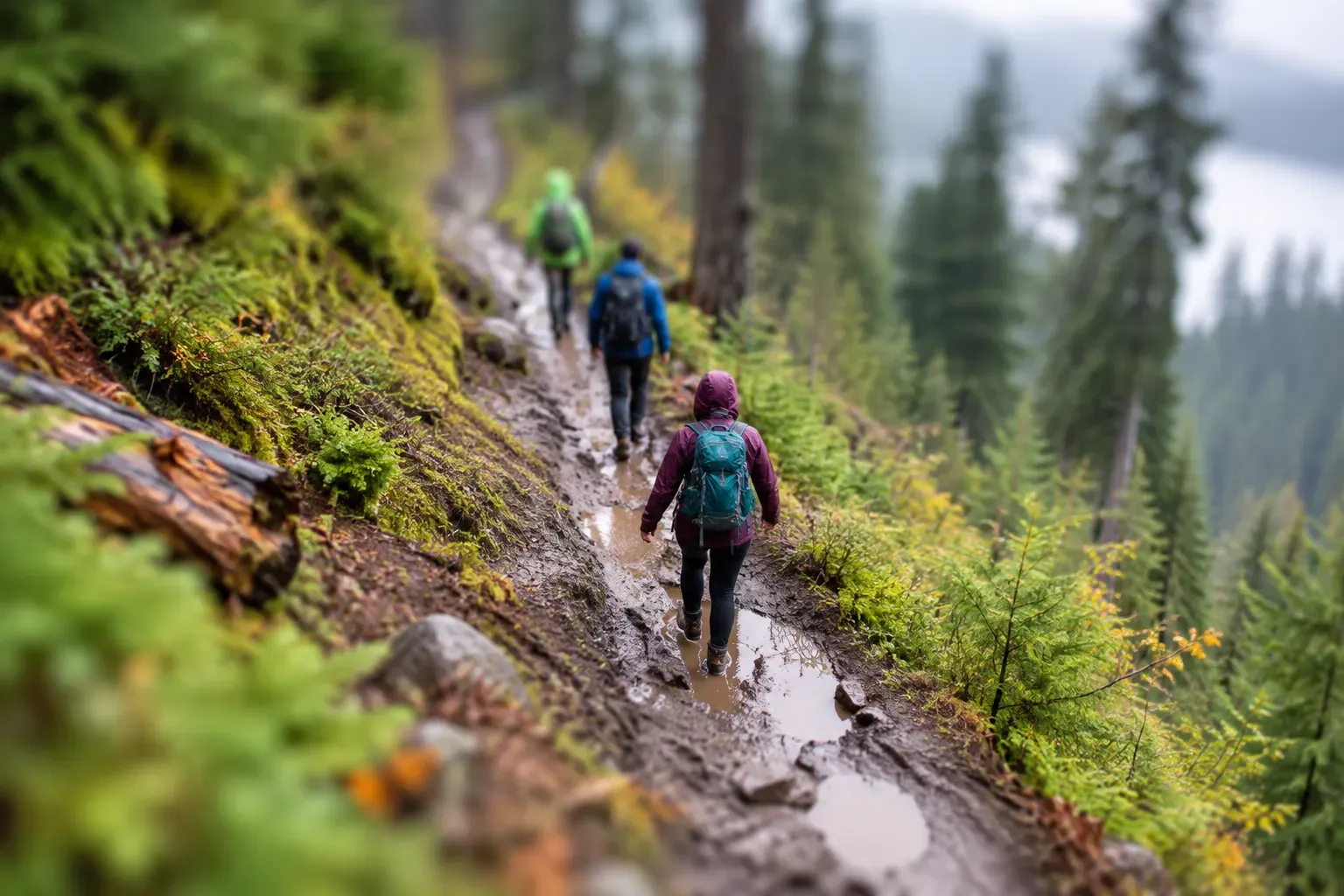
Keeping shoes tidy is a modest ambition. I would not let it quietly become a plan to widen a trail. On a Pacific Northwest day hike, an ordinary patch of mud can make the edge look like an invitation. The useful question is where the established route goes, not which nearby plants offer the cleanest passage.
Washington Trails Association explains that walking around mud widens trails and tramples vegetation. Its advice is to stay on the established tread.
Leave No Trace also discusses muddy trails in detail. Stepping off the designated trail to avoid mud can create undesignated trails and cause damage to vegetation and soil. This can also lead to erosion. The relationship between vegetation and soil protection is also explained in this discussion of muddy trails.
I would expect some mud on a wet day and plan to stay on the established route. The point is not to make discomfort virtuous. It is to avoid treating the trail’s edge as an extension of the walking surface.
There is a big difference between staying on the trail through ordinary mud and entering floodwater, unstable ground, or other hazards. Guidance about ordinary mud does not override a closure. If the route cannot be used safely as designated, change the outing.
Again, this distinction is important so as not to create a false choice between destroying the edge of the trail and going through mud to prove your “hardiness” on the trail. Turn around and go back down the trail if you are not prepared for the condition of the trail. Go on a different supported outing instead of continuing on a trail that is not appropriate for you.
For a group, I would discuss the plan before the first muddy section. People should know the group plans to stay on the route through ordinary mud. That gives everyone a chance to decide whether the outing suits them.
I would keep the discussion practical. There is no need to rank people by how dirty they are willing to get. They can care for the trail and decide that a wet outing is not for them on any given day.
Again, WTA’s guidance on switchbacks is relevant here. Switchbacks are designed to limit erosion. Cutting across switchbacks causes more erosion and damages plants on the side of the trail.
Remember, a trail’s purpose does not cease to exist after you have decided you are ready for lunch or home. Keep the form of the trail in mind throughout your entire outing, not just when you are appreciating it.
I prefer not to make up a story about how I saw another hiker do something bad on the trail and then talk about that instead of discussing the actual problem with the published guidance. It would be too easy to make readers think that I am inviting them to judge another hiker instead of just making clear the choice that I would like them to make.
Parents can explain where the route is and why the group is staying there. A family walk does not need to become an endless warning.
This article has no current status report for a particular route. I would check the land manager’s information before leaving and follow notices on the ground. Careful walking does not establish permission to enter an area.
The fact that someone has walked on the side of the trail does not make that a designated trail. It may be easier to see than the muddy middle, but footprints do not establish a designated route or a manager’s permission to use it.
I would pay attention to the route’s boundaries and the choice between following the tread and stepping into vegetation. I do not have to be an experienced backpacker to recognize this decision.
The decision of what repairs to make on a trail should be left up to the person or group responsible for that trail. This packet is not meant to be used as a guide for digging drainage, moving rocks, or creating alternative routes. An urge to help should not become authority to change the route.
I can take the route seriously and leave its management to the appropriate people. If I later describe the conditions, I would distinguish what I observed from what I assumed needed repair.
I dislike the idea that caring for public land must always look dramatic. There is a quieter kind of responsibility in accepting a muddy established line and leaving its edges alone. It will not provide an impressive photograph of personal sacrifice. It may simply mean the outing is less tidy than the picture formed at home.
The preferred type of outing for a cleaner or firmer trail would be treated honestly when selecting a destination for the outing. Broad labels such as “easy” would not be used to describe the conditions of a trail unless the person had current information about that trail. A realistic description of the preferred type of outing for a cleaner or firmer trail would be used to help others select a suitable trail for their preferred type of outing.
The goal is to make the choice clear and then enjoy the outing. Good preparation can leave less to debate in front of a puddle.
A land manager can direct people to a designated alternative. That differs from a path created by people repeatedly stepping around a puddle.
For a muddy day, I would check that the route is available and suitable. We would plan to stay on the established tread of the trail, respect the switchbacks of the trail and be prepared to change our plans for the day if necessary. The edge of the trail is not for dry shoes. I would prefer to come home a little muddy than to leave a wider trail than when we started.

Comments