
The Journal
Gun Time vs. Chip Time
Learn why running races report gun and chip times, how timing works and which time may determine awards or qualification.
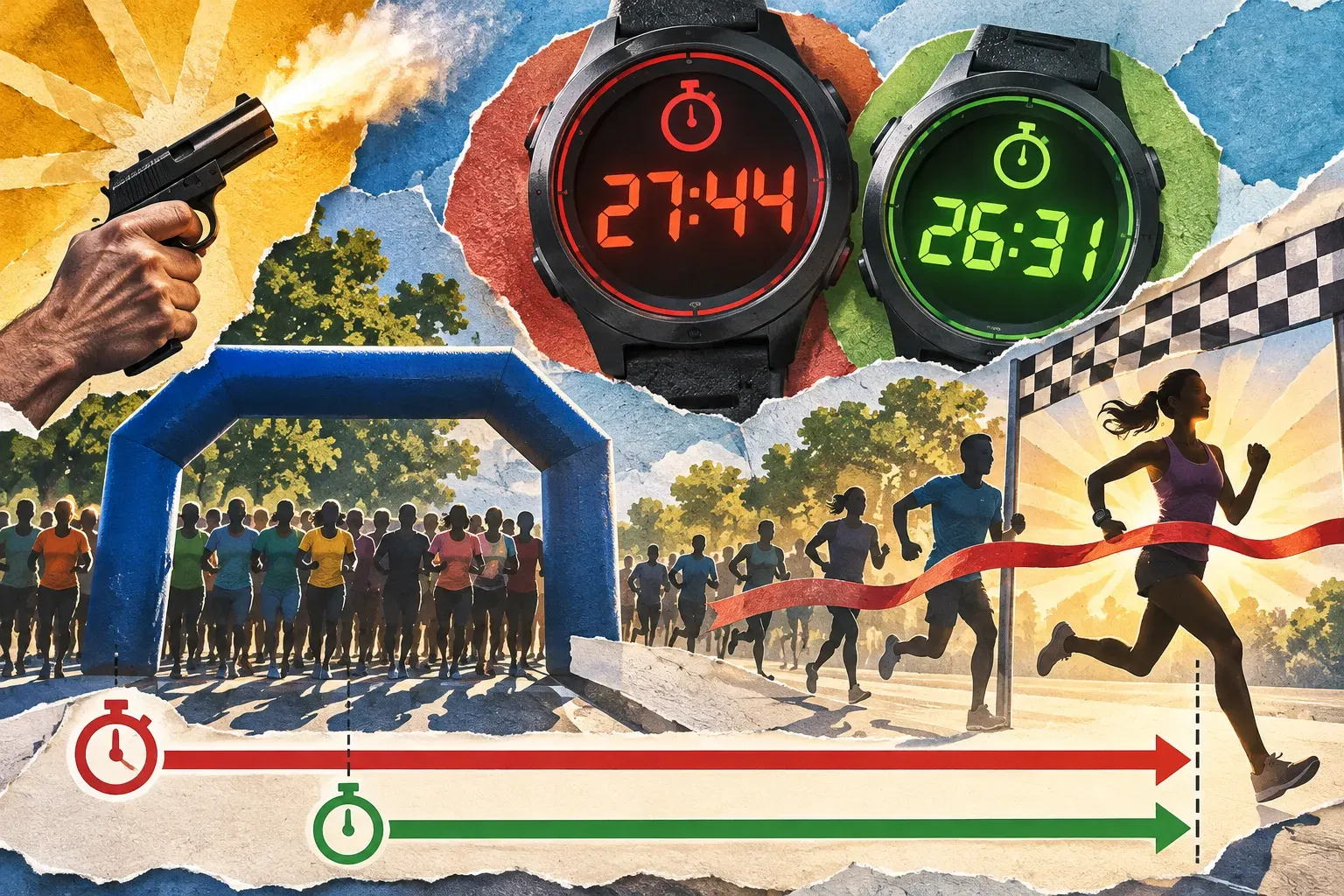
Race results can include more than one time for a single run. Gun time is the official start of the race to the finish of the race. Chip time, also known as net time, starts when you cross the start line and ends when you cross the finish line.
The difference is the time from the official start to the time you cross the start line. In a crowded 5K, that could be enough of a difference to make the two times look like results from different races. It’s just two ways to measure the same effort. Which time is used for what result or award depends on the event’s rules.
What Is Gun Time?
Gun time begins at the starting signal assigned under the event’s rules. This may not be an actual gun, but could be a horn or other signal. The time is then measured until you cross the finish line.
If the start is a mass start, then runners near the start line can get moving almost right away. Those farther back may have to wait for room to move forward. The wait time is part of the gun time. It doesn’t mean you ran a longer course or that there was a problem with the timing system.
Gun time can be useful for the overall winner of a race. It can allow for the ordering of competitors who start together based on when they finish. But make sure to look at the event’s rules. There may be different rules for overall places, age groups, etc. based on the organizer.
What Is Chip or Net Time?
Chip time is the time from when you are recorded as starting to when you are recorded as finishing. The event timing system will detect a timing device associated with your race number or equipment at those points. This often means there are timing mats or other timing detection equipment at the start and finish of the race.
If you are waiting behind a crowd to get to the start line, that waiting time is not part of your net time. It’s still part of the gun time, which is from the official start signal. You still have to follow the organizer’s instructions for the timing device and crossing the designated timing points.
What about wave starts?
Some races have different groups of people starting at different times. There may be a different start signal or clock for a wave, and the event’s rules will determine how that is measured. Don’t assume that all races will use the first wave’s signal for all runners. Look at the definition in the results guide for your event.
Why Can the Two Times Differ?
Here’s an imaginary example. This is not the result of an actual race.
8:00:00 official signal ---- 8:03:00 runner crosses start ---- 8:33:00 finish
         <---------------- 33 minutes gun time ---------------->
<--------- 30 minutes net time ---->| Hypothetical event | Clock time | Meaning |
|---|---|---|
| Official start | 8:00 a.m. | Gun clock begins |
| Runner crosses start | 8:03 a.m. | Net clock begins |
| Runner crosses finish | 8:33 a.m. | Both measurements end |
| Gun result | 33 minutes | Includes 3 minutes before the start crossing |
| Net result | 30 minutes | Measures start crossing to finish crossing |
The math doesn’t require a special device. It’s the same finish point, but different start points. The three minutes waiting time explains the three minutes difference.
Which Time Determines Your Place?
You need to look at the event’s published rules for this. A result may be official for one thing, but not necessarily determine every award. Look for separate sections for overall place, age group awards, prize money, qualification, etc.
For example, look at the competition rules for New York Road Runners. NYRR says that net time is the official time for finish order and age group awards, and top finisher awards are based on gun time. They also have rules for special event formats and exceptions. That’s just an example of what NYRR does. It’s not a rule for all races in the country.
If there’s a category award for your race, look beyond the word official in the results table. Look for the rule for that category. It’s possible to have a faster net time than another runner, and have a different place for the gun time award rule. Neither may be a mistake. Cutoff times raise a similar question, which what a race cutoff time is answers.
How Do 5K Race Results Display Times?
You may see a finish time, net time, gun time, overall place, age group place, etc. on an online results page. These labels are not universal. Some may use chip and net as interchangeable labels. Some may only display the measurement used for their published results.
Start with looking for the result for your bib (see how to wear a race bib correctly if you are unsure where it goes) instead of just searching for a common name. Look across the row and read the labels. If you see a number for overall place, that’s your place within the group defined by the race. If you see a number for age group place, that’s for a more narrow group. The event will determine which time and eligibility rules are used for each place.
If you see a pace and finish time, make sure you look at the distance and units before comparing that to your watch. A pace is the time per unit of distance. It’s not another finish clock. A split is part of a course. It needs its own distance label to be meaningful.
A split is an intermediate measure. It’s not the full finish time. A race may record a split at a point in the course, but don’t assume that all 5Ks have a split. Look at the label for the column and what the organizer says. If there’s no split, you may need to ask the timer, but don’t assume that means something’s wrong with your performance.
The results may be preliminary before the event finalizes the results. Someone may be missing from an early view. They may be added after reviewing an issue. Follow the event’s published process for corrections. Keep your own records. Don’t assume that what you see in an early screen capture is the final award list.
Make sure your name, bib, and division match the time. If something seems wrong, keep your bib number and contact the published results support for the race. There may be a correction window or specific form to use. Ask the organizer. Don’t post someone else’s result as proof of a timing issue.
A practical check after your first race
Go to the organizer’s results page. Find your bib. Read the labels before deciding that either time is wrong. For the example above, the difference in the two times is three minutes. If there were several different wave starts for the event, then you may need to look at the starting signal that’s assigned to your wave. See the organizer’s timing guide for the calculation.
Now compare the result to your goal. If you wanted to cover the course in less than 30 minutes, you can look at the net interval to see how long it took from when you were recorded as starting to when you were recorded as finishing. If you wanted to place in an age group, then look at the age group rule and the finalized category results. These are related questions, but they may not use the same column.
If there seems to be a missing timing point, then give the results team the information they ask for. Your bib number, distance of the event, and approximate time you finished may help them find your record. You can use your personal watch to help with context. But don’t assume your watch file will automatically replace a missing official reading. There will be a process for corrections and deadlines based on the event.
Save the final result and the timing label for your records. Months from now, it may be harder to understand a bare number than to have a note that says whether it was a gun clock or start mat. The label will make comparisons more useful without making every run a contest.
Why Did USATF Change Marathon Trials Qualification?
USA Track and Field announced on June 2, 2025, that they’re switching to chip time for the qualifying times for the 2028 U.S. Olympic Team Trials marathon. This was to improve consistency and accuracy. It’s also to make qualification fairer for runners who don’t have access to an elite start line.
This is the policy for the stated qualification process. This doesn’t mean that all marathons use chip time for awards. This doesn’t make any race automatically eligible for the Trials standard. USATF has a separate section on course certification, sanctioning, and other event requirements. If you’re looking for a qualifying mark, then you should look at the current rules for all the conditions.
Frequently Asked Questions
Which time is my personal record?
For your own training log, many runners like to use the net time. It’s from the start to the finish interval. Be sure to say which measurement you used when comparing efforts. For a formal record, team standard, qualifying application, etc., then you’ll follow the rules for that. Your training log doesn’t change the rules.
Is chip time always official?
No. The event will determine the official measurements and award rules. They may display both times and use them for different things. See the NYRR example above for why the category matters.
Why is my watch time different?
Your watch starts and stops when you operate it or when it’s set to do so. This may not be the same as the race timing points. Your watch may be useful for pacing and your own notes, but the organizer’s system and rules determine the published result.
Can a race use gun time only?
Yes. Don’t assume that an individual start crossing measurement is available. There should be information about the timing in the event. What is recorded and published should be explained.
How do wave starts work?
Different groups start at different announced times. The event will specify how the starts interact with the gun and net measurements. See instructions for your assigned wave. Look at the race’s timing definitions.
Save the results and award rules with your registration details before your next race. Then when you see two numbers next to your name, you’ll know what each number is meant to tell you.



Comments