Affordable for Whom Is the Question
I am interested in public announcements that claim to make access to public lands more affordable. The Department of the Interior’s November 2025 announcement raises a question about who benefits. This announcement makes two distinct promises, one of convenience and another of pricing, and they should be judged separately.
The announcement was published on November 25, 2025 and described a January 1, 2026 launch. It set the Annual Pass at $80 for U.S. residents and $250 for nonresidents. Nonresidents without an annual pass were to pay an additional $100 per person at 11 of the most visited parks in addition to the regular entrance fee.
The department framed the policy as benefiting taxpayers and said fee revenue would support facilities, maintenance and services. I support caring for public lands, but I can still question how the money is collected.
My main concern with the way public land is discussed in the above announcement is that of value. I want public land discussed as something we care for, rather than something whose worth depends on how effectively we sort prospective visitors.
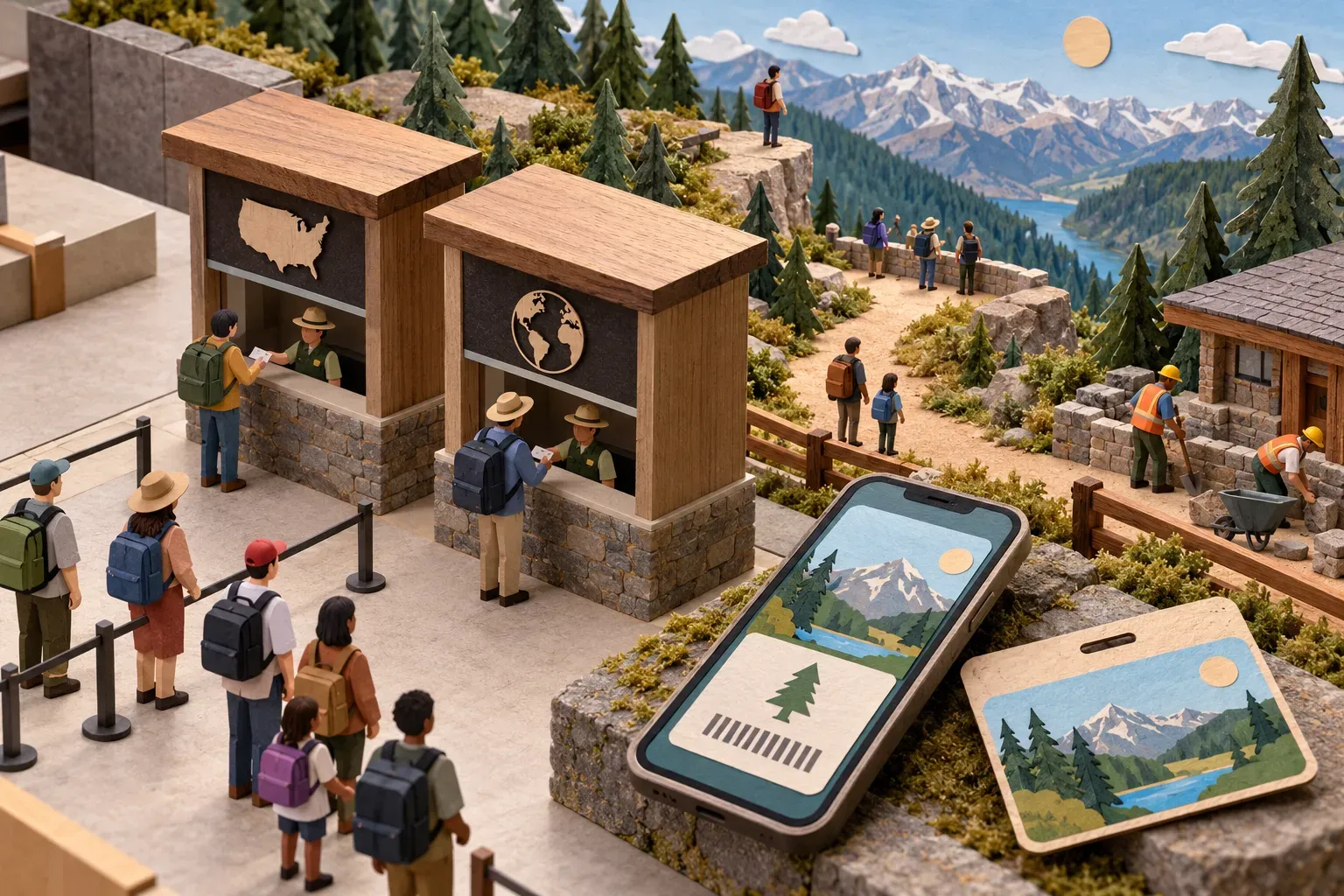
The same announcement described digital America the Beautiful passes through Recreation.gov, stored on mobile devices and linked to physical cards. This is a nice convenience, but it does not address the issue of the fee for public land access itself.
I am a public librarian. My work there naturally leads me to ask the question of who a service is for. A library and a national park are not identical. My work gives me a reason to pay attention to public access and to resist treating convenience as a complete definition of it.
This is a different issue than whether the pass is easier to use. I want both ideas expressed plainly. A person can approve of one and question the other without being confused about the policy. Combining them under a cheerful description asks the reader to accept more than the convenience claim can establish.
For now, I would like to focus on the actual distinction that is made in the announcement between residents and nonresidents. I can disagree with this distinction, but I cannot pretend that the announcement said something else. My criticism should help to make clear the policy that has been announced.
My objection concerns the announced terms and how affordability is presented. The announcement does not tell me what revenue arrived, what maintenance was completed or how visitors responded.
The announced terms of public land access are what I wish to discuss. I want to discuss the welcome public institutions offer. I want maintenance taken seriously without treating every criticism of a fee as opposition to maintenance itself.
An announcement such as this is a part of the service that the Department of the Interior provides to the public. If affordability is the claim of the announcement then the stated prices for access to the parks should be near the claim. If maintenance of the parks is the justification for the fees then the planned use of the revenue for maintenance should be clearly stated.
I have no interest in assigning private motives to the officials behind the announcement. The published choice is enough to examine. Speculation about what someone secretly wants makes a column louder without making its reasoning better. I would rather be direct about the principle I object to and fair about what the source establishes.
The published choice is enough to examine. Speculation about what someone secretly wants makes a column louder without making its reasoning better. I would rather be direct about the principle I object to and fair about what the source establishes.
I do not want a visitor’s nationality to become a substitute for discussing the policy itself. I can argue for a wider sense of welcome without claiming to speak for everyone the terms might affect.
The account of the policy should report on the work with the money, and on the access to the parks with as much detail. I would expect such an account of any fee, whether I supported it or not.
Digital convenience sounds useful. The unequal prices deserve scrutiny. The promise of affordable access to public lands must be spelled out for the audience that is intended to benefit from such access. We must care for our public lands and we must honestly describe the invitation to use them. A nice pass is not enough to answer the question of who is being welcomed to public lands.



Comments