Halloween Safety Starts Before Sunset
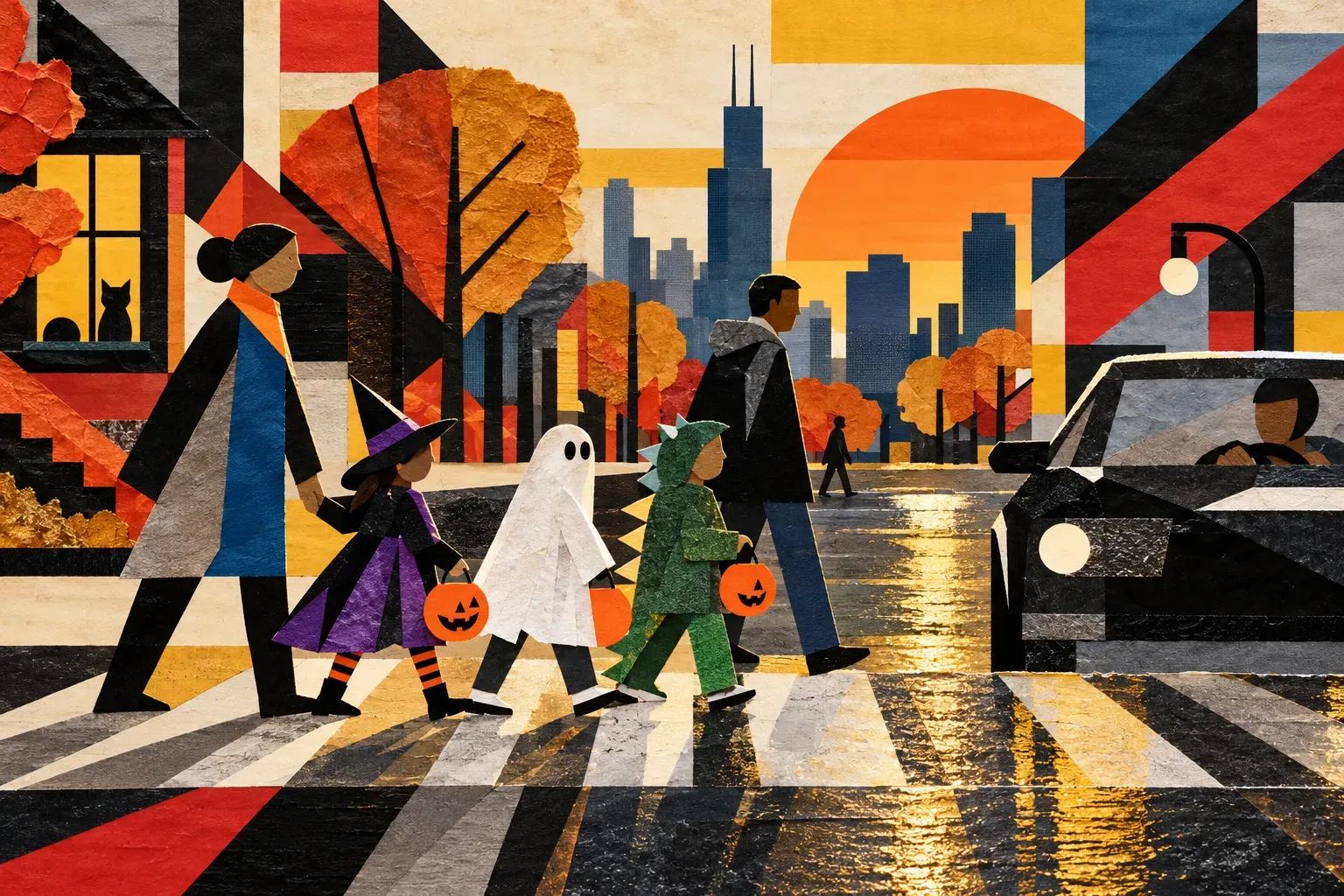
The Halloween crash study’s afternoon finding deserves attention. Its largest hourly increases in pedestrian crashes came at 3 p.m. and 4 p.m. An account focused only on darkness would miss that finding.
The study was released by the Chicago personal injury law firm of Taxman, Pollock & Bekkerman and research agency 1Point21 Interactive on October 28. The study analyzed city crash data from 2021 through 2025. It is not a prediction for the current year.
For each year, the researchers counted crashes from midnight on October 31 through 4 a.m. on November 1. They compared that period with the same hours on other days falling on the same weekday that year.
Crashes of all types rose an average of 17.6% in the Halloween window over the 5 years studied. This is a very different number than the increase in pedestrian crashes, which on average rose 62.2% in the Halloween window.
The study looked at the 2025 numbers for the Halloween window of midnight on October 31 to 4 a.m. on November 1. There were 21 pedestrian crashes, compared with a same weekday average of 10.1. The study calls that a 107.6% increase. It should not be confused with the 5 year average or used to predict what will happen on Saturday, October 31, 2026.
People under 18 made up 22.6% of pedestrians in Halloween crashes, compared with 14.4% on comparable days. Children ages 3 to 9 accounted for 6.5%, more than double their usual 2.9% share.
Pedestrian crashes involving injuries averaged 12.4 on Halloween, compared with 7.9 on comparable days.
The researchers suggest that the afternoon increases may line up with school letting out and Halloween activities beginning as sunset comes earlier in fall. That remains a possible explanation. An unnamed researcher from 1Point21 also said, “The afternoon spike also suggests the risk starts well before dark.”
People in the roadway made up 38.8% of pedestrians in Halloween crashes, compared with 31.4% on other days. That category does not tell us why each person was there, so it is not evidence of carelessness.
In 2014, a turning driver clipped me in a marked crosswalk and broke my left wrist. That is part of why I pay attention to crossings. It is not evidence for this study, and it does not tell me what happened to the people in these records.
The study is recommending that adults accompany young children on Halloween, and that pedestrians use reflective materials and cross at crosswalks. For drivers, it recommends obeying speed limits, putting phones away and never driving impaired. All of these recommendations deserve equal attention and space.
I do not want to write a column that focuses on making children visible. That would not fairly represent the study’s recommendations. The study addresses drivers too, and their part deserves space in the main account.
The useful message has a time attached. The afternoon deserves attention, not just the hours that look most like Halloween in a photograph.
I want this year’s walks to be enjoyable for children and adults. The study can provide us with a dated account of crashes in Chicago and some very solid recommendations for how to be safer on the streets, but that is all.
This study was released by the law firm of Taxman, Pollock & Bekkerman, and research agency 1Point21 Interactive. I think naming the source is part of fair use of its findings. Readers can then judge the report for themselves.
In 2026, Halloween will fall on a Saturday. Keep the afternoon in the safety conversation and include everyone the recommendations address.
Comments