A Summit Number Needs a Date
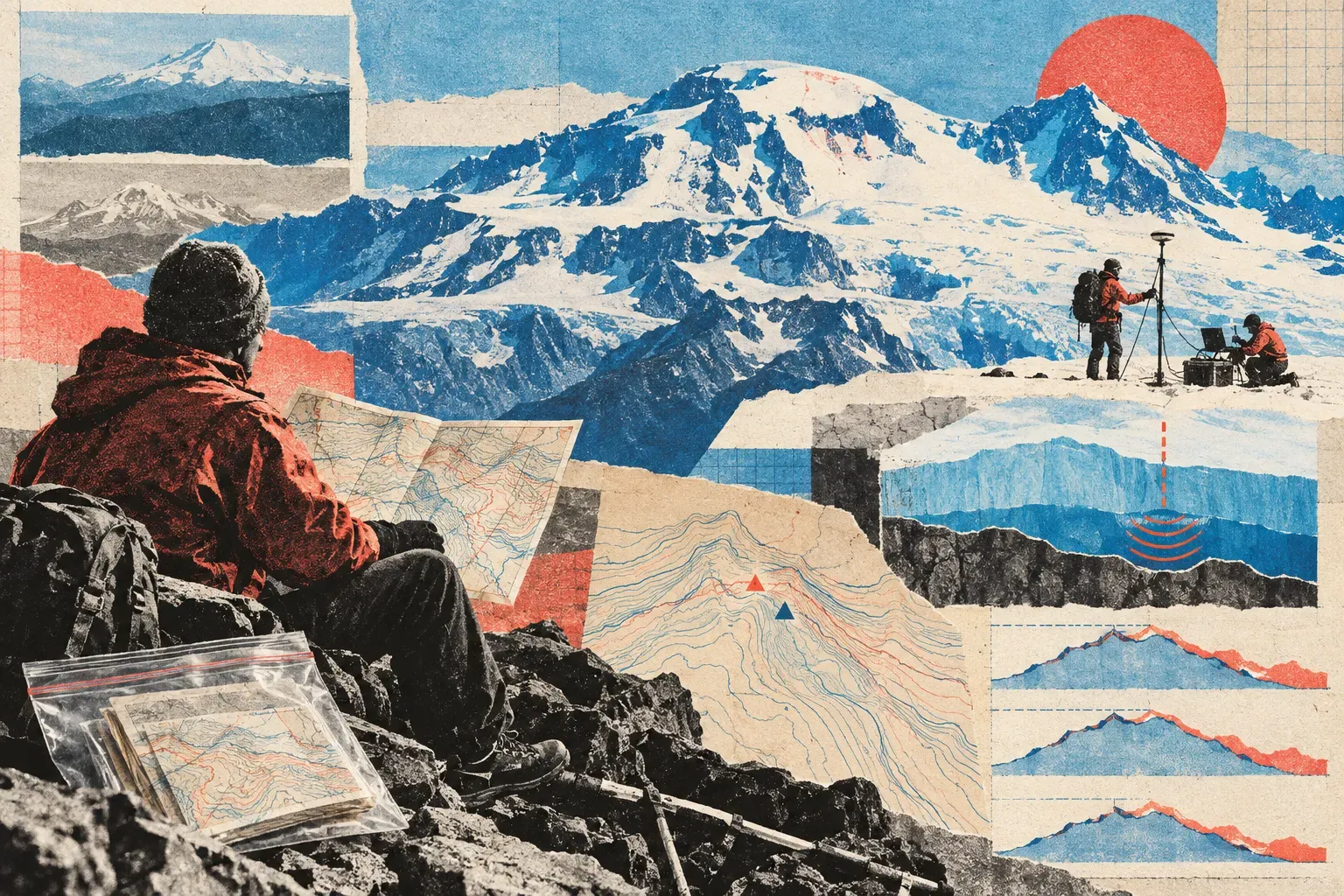
A printed summit number can look settled long after the surface it describes has changed. That is why I like a map that shows the age of its information.
In a preprint submitted December 6, 2025, Eric Gilbertson and his coauthors report measurements of Columbia Crest and Liberty Cap. They place Rainier’s highest point on its southwest rim, rather than Columbia Crest.
As a land surveyor for about 40 years, I like to be able to check a measurement. Of course, that measurement does not have to agree with what I had printed on my map years ago. It can change and that is good. What the authors of this report measured and wrote about is of more interest to me than whether or not their findings disagree with what I had printed as the summit of Mt. Rainier.
The authors measured another loss of 0.37 meters at the summit of Columbia Crest and another loss of 0.67 meters at the summit of Liberty Cap since the previous year’s measurement. I did not take these measurements and cannot certify them from Salida. I appreciate that the authors returned to measure again.
There is something reassuring about returning to re examine a measurement that has changed. I would be more troubled by a refusal to question a measurement again.
The authors used ground penetrating radar to measure ice thickness. Their projection for Liberty Cap reaching bedrock by 2047 assumes recent rates continue. A projected year is different from a measured height. I would keep that condition beside the date.
What I as a reader want to know is how the findings of the authors were arrived at. That can be done with plain wording. I can take the authors’ findings seriously and still ask how they reached them. I can be interested in a projection of some future event and yet not consider that event to be certain to occur.
The report is a research preprint. The supplied record does not establish peer review or an official map revision. My description of this report is based on the authors’ report of their work, and not on the acceptance of that work by any agency or agencies.
The paper maps that I still use are kept in a zip bag. I do not consider the findings of this report to be sufficient reason to discard my maps. What I will be looking for in future maps is a greater understanding of the landscape as it exists today, rather than what it was like years ago.
The discussion about Summit Numbers is more than just paper against electronics. My habit of checking things is older than my GPS unit. What I am interested in is to look for the basis of an answer, not to argue about the tool that was used to come up with that answer.
I would like to separate out admiration of a Summit Survey from ambition to reach the highest point on the mountain. These measurements do not give me a route assessment. I have no basis here to tell anyone where to climb or what is safe on the mountain.
The report is about measurement, and that is what I am interested in. It asks us to examine our belief about what we think we know, and that is of more interest to me than whether or not a mountain has decreased in height in order to become less impressive.
I have never liked judging ground by the prestige of a number. A view does not have to meet a height requirement before I can enjoy it. My walking has become gentler since knee surgery. I can care about an accurate summit measurement without treating the measurement as a ranking of the walks still available to me.
Another responsibility of anyone passing on this report is to leave the authors’ names and the date of the report attached. This will allow the reader of the report to find out more about the work of the authors and to form their own opinion about their findings.
I would welcome a conversation about how we read and maintain our picture of a place. I would resist using this report to dismiss every earlier effort or to promise a future the authors have made conditional.
What stays with me is the willingness to go back. The report gives readers another dated measurement to examine. It is useful work. Keep the date on the number, keep the condition on the projection, and keep the credit with the people who did the work.

Comments