A Large Spider Is Not a Large Threat
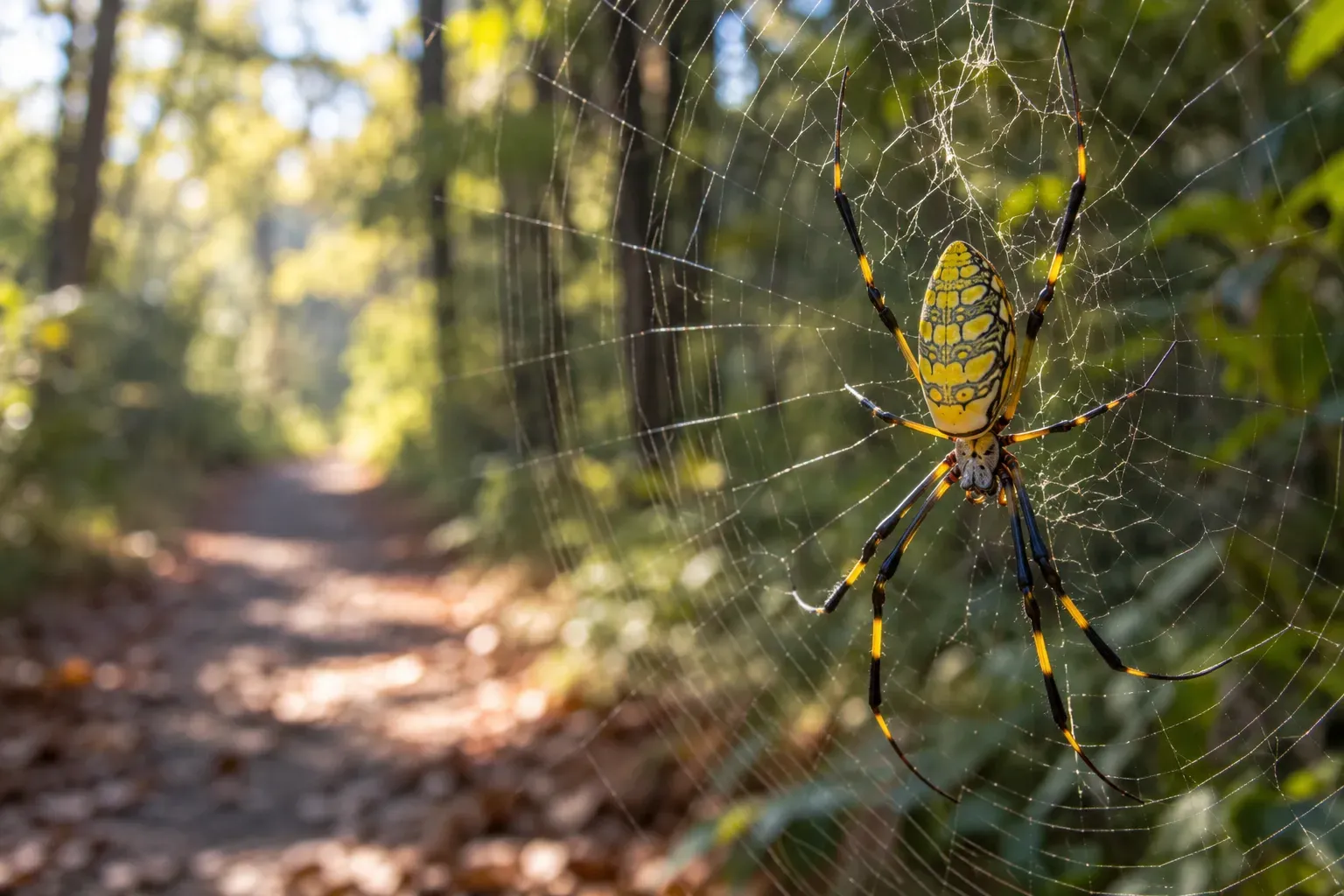
You have somewhere to go, and a spider’s web is in your way. That nuisance is real, but it is a poor measure of the danger posed by the spider.
According to University of Georgia Extension, the Joro spider is a very timid creature, unlikely to bite and not of much danger to people. Researchers found Joros reluctant to bite during rough handling in experiments. A rare bite causes brief discomfort and is not a medical concern, according to Extension.
Female Joros reach their largest size in late September and October as they carry developing eggs. Their bodies can measure up to 1 1/4 inches, not counting the legs. Yellow bodies, blue green bands, and long black legs with yellow bands make them hard to overlook. The brown males measure about 1/4 inch.
That contrast helps explain why you notice them now. Joros have 1 generation each year and are most visible in September and October. Their webs can be very large, many stretching several feet across paths and other clear areas. This can be very unpleasant but is not reason to cancel a walk.
I am a physical therapist assistant and care about things that would keep people from going out the door to go for a run or walk. So, yes, fear of things that look scary is a real thing. But, things that look scary are not necessarily aggressive. Extension says a Joro will probably retreat.
The Joro spider is native to East Asia and was first found in the United States in Georgia in 2014. UGA researchers believe that they may have come to the US on imported plants, crates or pallets as early as 2010.
In the Atlanta area, Joros became especially common around 2022. Reports on iNaturalist and EDDMapS have increased each year since then. The species is established in North Carolina, South Carolina, Alabama and Tennessee. Smaller populations have been found in Florida, West Virginia, Virginia, Maryland, Pennsylvania, Massachusetts and California.
Young spiders can spread by releasing silk and riding the wind for miles in June. Researchers call this ballooning. Cars, cargo and plants carry them too. UGA says wiping them out is no longer possible. That makes promises about stopping their spread worth examining with care.
Removing spiders or clearing webs in your own yard will probably reduce the number you see there for a time. It will not slow the wider spread, according to UGA. Those are different outcomes. You can care about having a usable walkway without claiming that your yard work will settle the larger question.
Clemson researchers tested household products including bleach, hairspray, rubbing alcohol and vinegar. The products did not work. Most spiders escaped harm or recovered fully.
Researchers do not yet know whether Joros will cause damage or remain chiefly a nuisance to the wider environment. This is still an open question, and researchers are still learning exactly how Joros fit into Georgia’s ecosystems, and many questions remain unanswered.
That statement deserves to survive our wish for a tidy verdict. It is possible to know something about bites and still have questions about the environment. The uncertainty in the second question does not erase the findings in the first. Nor do the bite findings settle every question about the species.
They eat moths, flies, mosquitoes, bees, wasps, beetles and stink bugs. A DNA study of their stomach contents found more flies than any other insect group.
As a physical therapist assistant, I value an explanation that leaves room for the next piece of evidence. We should take the nuisance seriously without making it frightening, and take the unanswered questions seriously without pretending they are answered.
A sighting can be recorded without requiring you to decide what the species will mean for every place it reaches. That judgment remains a question for research, not a condition of taking part.
You can report your sightings to Joro Watch at jorowatch.org. You do not have to admire the spider to find the research useful. Understand what is known, and keep the size of the fear in proportion.



Comments