A Dark Training Walk Needs Its Own Plan
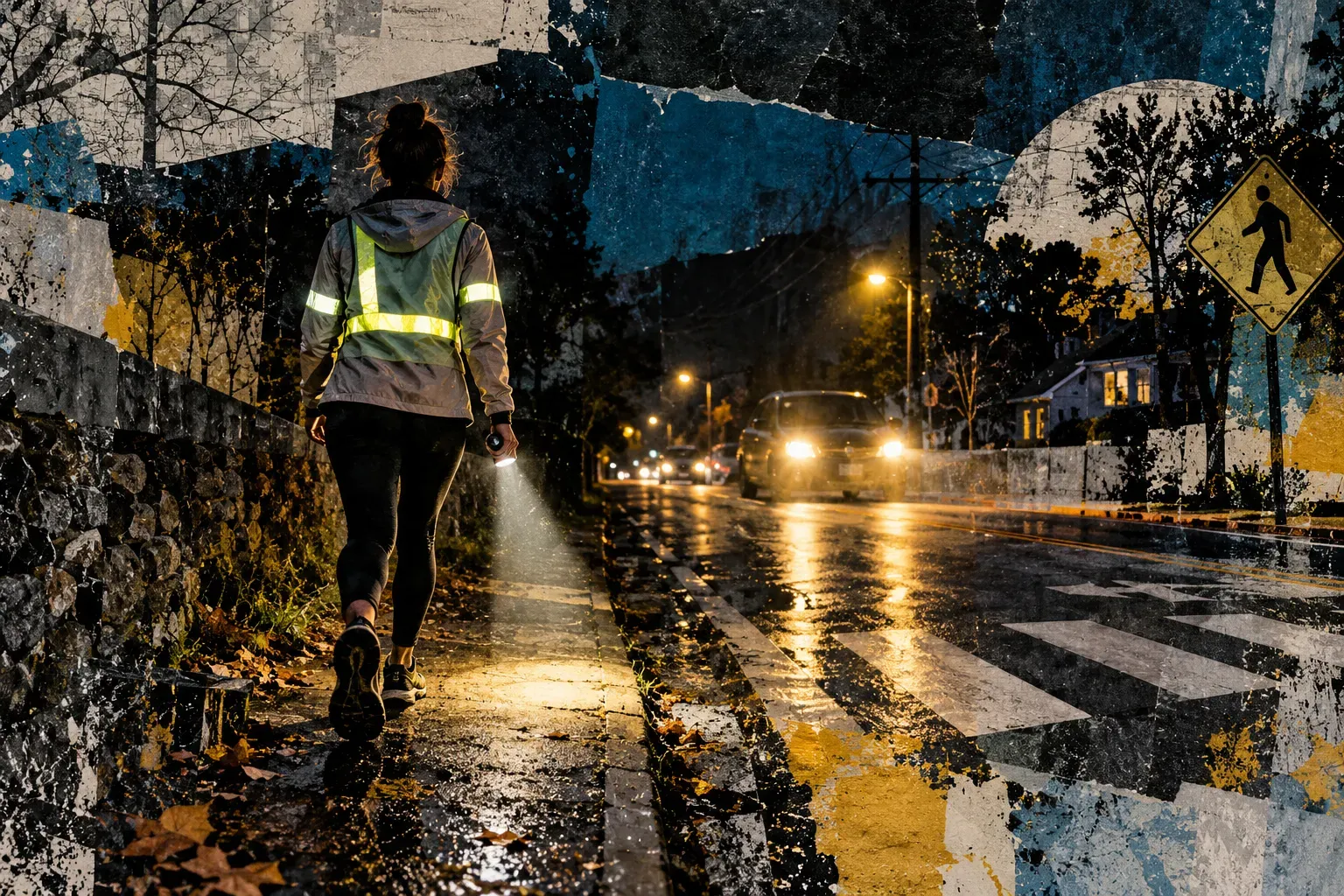
A dark training walk needs its own plan. An ordinary walk before work is not a closed road race. I would keep that difference in mind before borrowing the confidence of an organized event for a dark training route around home. The road outside your door needs its own reading for the best place to walk and how to be seen.
The National Highway Traffic Safety Administration’s pedestrian guidance for road walking states that pedestrians should use sidewalks if available. If there is no sidewalk, the agency advises facing traffic and staying as far from vehicles as possible. Those instructions are for ordinary road walking. I would not transfer them to an organized course with its own directions and traffic control.
For a local walk, first check whether the proposed route provides the space described in the guidance. The answer belongs to the actual route. I have no current inspection of a North Georgia street, and a town name alone would not establish whether a particular stretch is suitable.
That is a reason to plan carefully, not a reason to make a beginner feel unwelcome. You should not have to enter a race to care about walking safely. Check for sidewalks and crossings, and consider what the route requires outside an organized event.
NHTSA’s low light advice for pedestrians states that there is a difference between being visible during the day and being visible at night. It recommends reflective materials and a flashlight. It notes that white clothing alone does not guarantee a driver can see you.
There is more than one task to prepare for a dark training walk. Illuminating the path in front of you is one task, but being visible to drivers is another. Use the NHTSA guidance for both tasks. Do not rely on one piece of equipment to prepare you for all of the different situations of a dark training walk.
This source packet contains no product test. I have not tried a featured light, garment or shoe for the article. The aim is to understand the job before considering a product claim that seems to complete the plan.
All crossings are included in the route that you walk. Pay attention to the crossing, not just the road before and after it. This is why NHTSA advises pedestrians to cross at crosswalks or intersections whenever possible and to watch for turning or backing vehicles.
The same guidance asks pedestrians to remain alert. I would want the things I carry to support that attention. This is not to say that I have observed some local hazard or tested some electronic device on the market. Rather, it is to relate the agency’s instructions to decisions that we all make on a regular basis.
Drivers have responsibilities too. NHTSA calls for slowing down, watching for people, yielding at crossings and taking extra care at night. Equipment on a walker does not replace a driver’s obligations.
I am a physical therapist assistant and a runner, not a traffic engineer. I can explain the published precautions without certifying a road design. If a particular route leaves unresolved questions, I would not fill the gap with reassurance about how many people probably use it. The popularity of a route has not been established in this packet either.
For someone fitting activity around a schedule, low light can be part of choosing an outing. I would prefer a plan with understood practical requirements over one selected only through habit. Darkness does not make every outing impossible. The choice needs more information than the distance you hoped to cover.
I like keeping the distinction between preparation and a guarantee visible. The agency provides precautions. It does not promise that reflective material, a flashlight or a crosswalk eliminates every risk.
The next step would be to review a route for possible dark training walks using the agency’s guidance for the chosen activity. Identify the walking space and crossing decisions, then consider the lighting and reflective material advice. For organized events such as road races, use the rules of that event rather than applying guidance for ordinary road walking.
Before choosing equipment to assist with visibility on the route, first determine what areas of the route are of concern and what questions remain unanswered regarding the route. A product can help to illuminate dark areas of the route, but it cannot answer questions such as whether there is a sidewalk on the side of the road on which you are walking or how to cross a particular street.
Treat a dark training walk with the same respect as a walk that happens to take place at a more convenient time of day. This is about making informed choices about the route, shared responsibilities and limitations of the equipment used. This is a practical plan, not a promise.

Comments